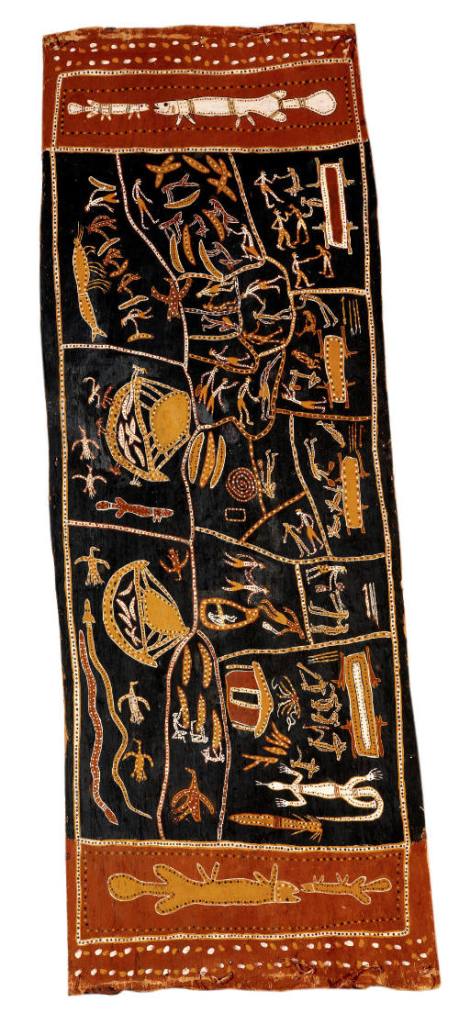
A bark painting with coloured ochres by Wainburranga (Paddy Fordham) titled The Makassans – the Muldi.
The painting is divided into 12 sections or ‘chapters’ and tells the story of the Rembarrnga people trading with the Makassan (or Macassan) fishermen and with Northern coastal Aboriginal communities.
The work is divided into 12 individual sections which are referred to as ‘Chapters’ by the artist. A series of 12 drilled holes appear at top, 6 at centre and 12 at bottom of the work, with some chord wound through each hole and attached to wooden sticks to provide support for the object. The 12 sections represented in the painting have been listed as:
Section 1 – the Saratoga saltwater fish is also the wind tester
Section 2 – the Rembarrnga and their traditional food
Section 3 – Rembarrnga men are preparing the trepang (sea cucumber) to eat
Section 4 – a Makassan boat (perahu) is anchored offshore full of trepang, the Makassan fishermen have left their boat to meet with the Rembarrnga
Section 5 – the Makassans carry gifts, one man has remained on the small dinghy to make sure that it does not float away
Section 6 – the Makassans greet the elder male Rembarrnga
Section 7 – a Rembarrnga woman goes with the Makassans in exchange for flour and tobacco
Section 8 – the gifts of the Makassans are displayed: trepang, havlock chewing tabacco and smoking tobacco
Section 9 – after spending a night with the Makassans, the Rembarrnga woman returns with gifts: flour and tobacco
Sections 10-11 – the Makassan and Rembarrnga collect and prepare the trepang with the lobster symbolising the abundance of food in the area
Section 12 – the Rembarrnga farewell the Makassans telling them to come back the next season
Collection: Australian National Maritime Museum
 Drinking in the Cemetery